
Impact Sled Update: Small Overlap Rigid Barrier Development
May 7, 2026
As a follow up to last year’s impact sled article, MGA is excited to share newly added crash modes for our dynamic impact sled system. As a part of our continued effort to replicate virtually any crash test at a component or system level, MGA has fabricated new impact forms and developed several new test configurations. These updates expand the sled’s capability to replicate real-world crash conditions along with regulatory crash simulations on components and sub-systems earlier in development—helping teams evaluate energy dissipation, attachment retention, and failure modes with repeatable boundary conditions and high-quality data.
MGA’s New Impact Forms and Test Configurations
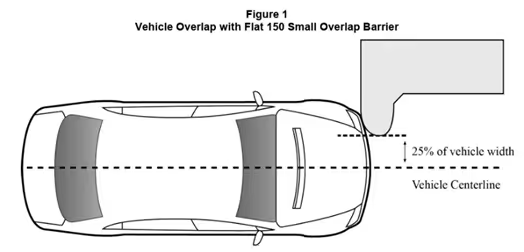
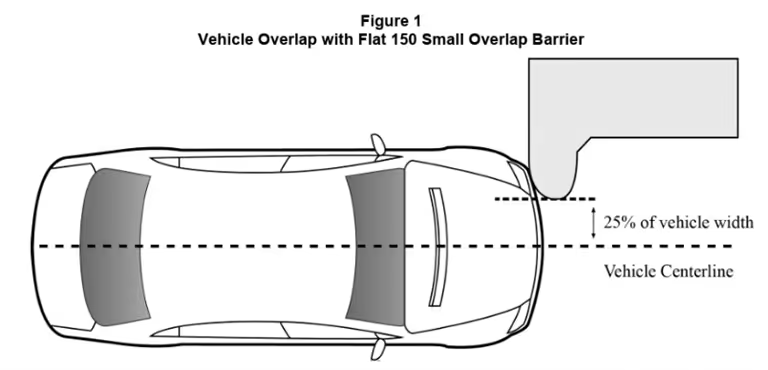
The most notable addition is the development of a system-level evaluation for the IIHS Small Overlap Rigid Barrier (SORB) test. An overhead view depiction taken from IIHS.org is shown above. The SORB test is a narrow, 25% overlap at 40 mph, that avoids the vehicle’s primary front crash structure and instead loads the outer structure—wheel, suspension, fender/hinge pillar area, and the front of the occupant compartment. Because the contact area is small and offset, the test focuses heavily on load-path management. The structure must absorb and redirect energy without allowing excessive intrusion to the occupant compartment, while the restraint system must control occupant motion as the vehicle rotates and the struck wheel and suspension push rearward. The impact sled focuses on the performance of this test outside of the occupant compartment.
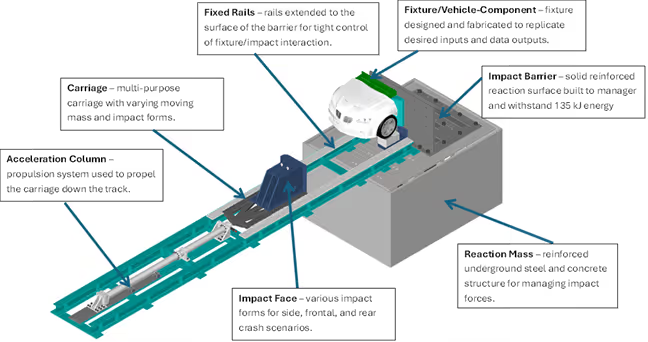
For SORB impact sled testing, MGA uses a rigid, modular fixture to secure the front drivetrain and suspension assembly to a rigid barrier interface. This enables controlled, repeatable testing of localized small-overlap loading paths while supporting measurement of component responses (e.g., wheel compression, ejection/retention, and subframe/strut load transfer). The fixture is typically modular to allow for easy assembly of the tested components. Both front wheels are supported by a fixture that simulates the ground to keep the vehicles’ suspension compressed as it would be during the full vehicle test. Both the struck and unstruck sides are unconstrained and can rotate freely during impact. Typical SORB impact sled studies are conducted between 80-130kJ. MGA’s current system has an operating mass of 1,800 kg with our SORB impact face installed. Mass and velocity can be adjusted depending on customer requirements. Instrumentation typically is tailored to the project and currently includes accelerometers, angular rate sensors, contact switches, tear switches, a tire pressure transducer, string potentiometers, and load cells.
With over 40 years of crash safety testing, MGA’s engineers continuously push the limit of how early development crash simulation can provide our customers with huge savings in both prototype vehicle costs and the duration of the vehicle’s design cycle from start to finish. MGA will continue expanding the impact sled’s library of crash modes and impact forms to support industry needs. We are continually testing modes for axial crush, side impact, and 3-point bend at a component-level along with system level studies for front, side, and rear impact conditions. If you have a target load case or would like to explore component or system-level evaluations on the sled, please reach us here.
Ready to Get Started?
Let's discuss your testing needs and how MGA can help. Our team is ready to provide the expertise and solutions you're looking for.