

Hydraulic Durability & Chassis Testing
MGA leverages over 20 years of experience, state-of-the-art facilities, and expert engineers to provide industry-leading hydraulic durability testing services for automotive, aerospace, and other industries.
Quick Overview


Fatigue and Cyclic Durability
Wide array of strength and durability testing on chassis and suspension components and systems.
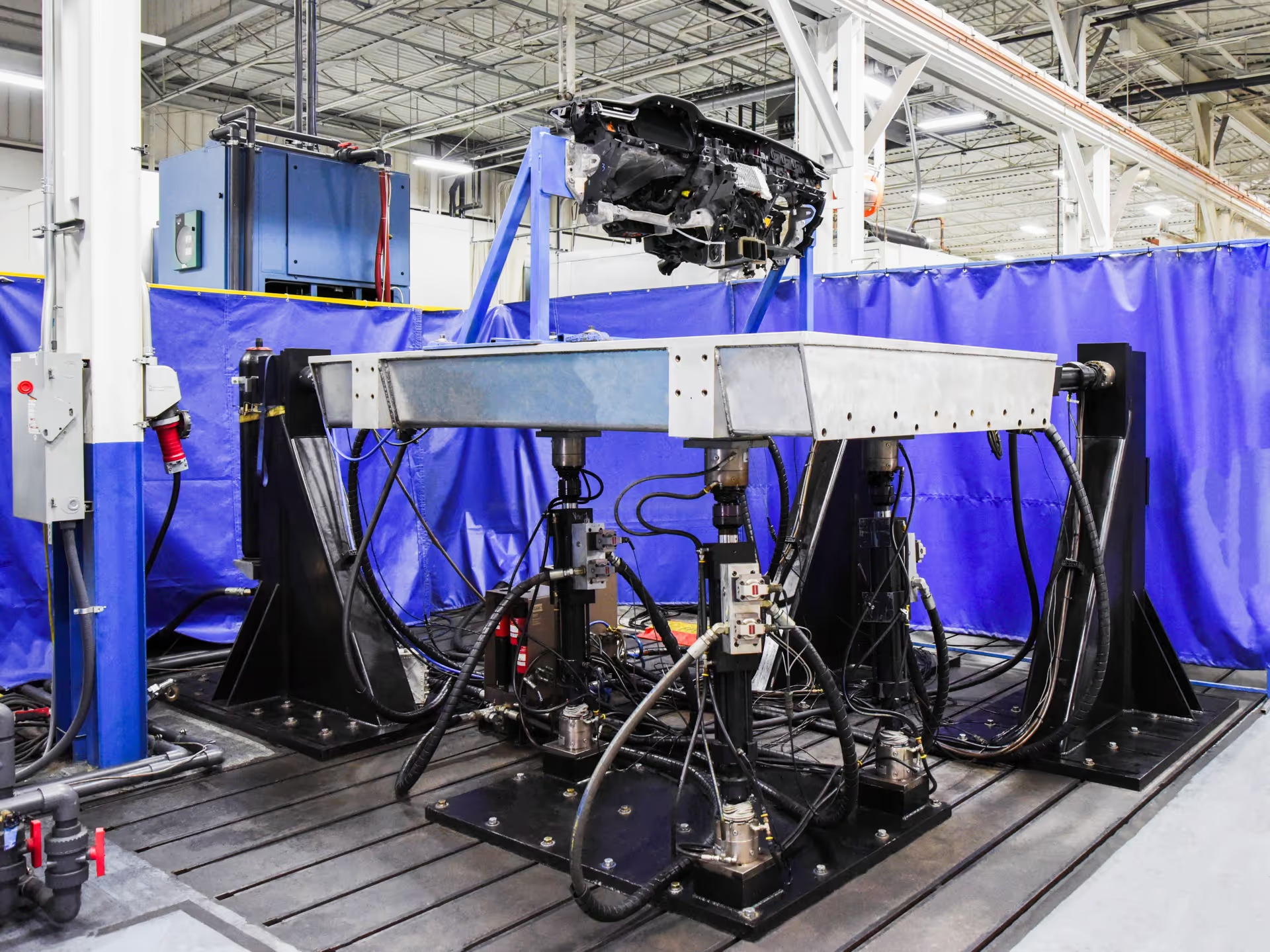
Multi-Axis Simulation
Over 20 MAST tables with semi-anechoic and environmental capabilities using the latest MTS® FlexTest Controllers

Comprehensive Real-Time Simulation
We provide real-time simulation testing for a wide range of components, from individual parts to full vehicles, using MTS® RPC® Pro software.

Advanced Data Acquisition Capabilities
We offer extensive road load data collection and analysis services, with the ability to record over 100 channels of data and create custom instrumentation solutions.

Non-Destructive Inspection Services
We conduct Dye Penetrant Inspections (DPIs) to identify and track issues throughout the testing process, ensuring thorough evaluation of component integrity.
Introduction to Hydraulic Durability and Chassis Testing
MGA’s hydraulic durability infrastructure is built to support full-vehicle, system-level, and component testing at scale—combining high-capacity equipment with flexible, custom-engineered solutions.
What is Hydraulic Durability Testing?
Hydraulic durability testing evaluates a component or system's reliability and performance under input from a hydraulically driven test rig by simulating a lifespan under various conditions. MGA’s Hydraulic Durability group has established itself as a leader in validating components and assemblies across various industries, including:
- Automotive (OEM and aftermarket)
- Off-road
- Aerospace (nondestructive and structural testing)
- Public transport (bus/train)
- Space
- Military
MGA's Hydraulic Testing Capabilities
Testing Facility Overview
MGA has been conducting hydraulic durability (HD) testing for over 20 years, and in that time has developed a national reputation for high-quality testing services. MGA has performed an abundance of projects on systems and components, including frames, chassis, suspensions, exhausts, trailer hitches, seats, and other interior and exterior components. These durability tests have been conducted for a wide range of foreign and domestic OEMs and their suppliers.
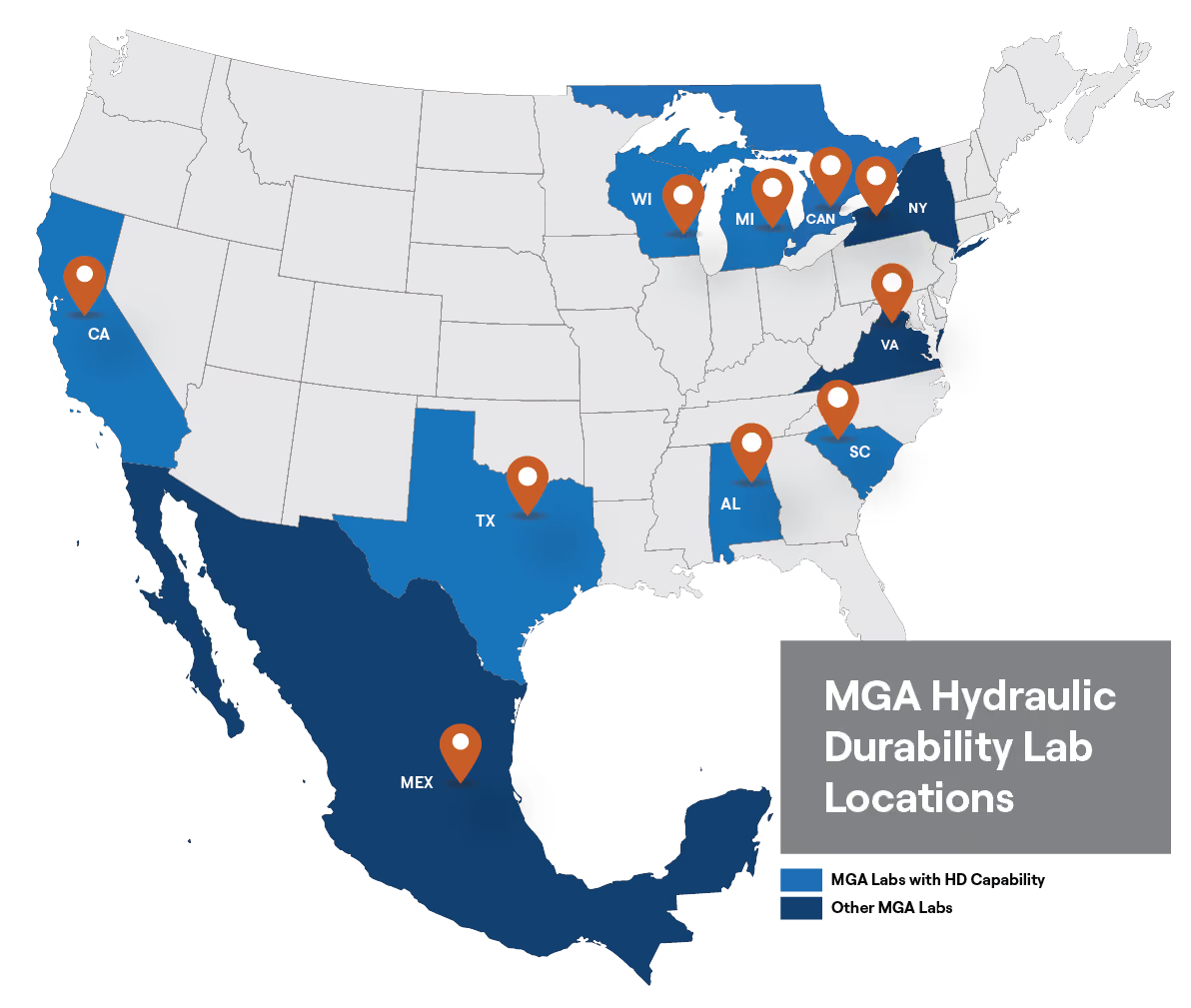
To meet industry demands, MGA has significantly expanded its capabilities over the past two decades, commissioning multiple new labs across our North American locations with 24/7 staffing and test monitoring. MGA’s laboratories are equipped with a comprehensive array of hydraulic equipment, ranging from Multi-Axis Simulation Tables (MAST) to custom multi-input setups.
Test Equipment and Systems
Hydraulic Systems and Control
At MGA, we have over 400 hydraulic actuators, ranging in size from 2.2 kip to 600 kip force capacity. For high-speed applications, MGA also has hydraulic cylinder testing with 3-stage valves that are capable of 100+ in/s. Our hydraulic actuator models are capable of displacement capacities over 20 inches.
We can recreate most environmental conditions, including hot, cold, humid, and sun-exposed conditions. For MAST rigs, we have environmental chambers, semi-anechoic chambers, and some with both capabilities. MGA has the latest control systems, including MTS FlexTest® controllers and software.
The Hydraulic Durability Group at MGA operates an extensive testing infrastructure, with each lab featuring sizeable bed plates with reaction masses and up to 400 gpm of pumping power.
Across our facilities, we have over 16,000 sqft of bedplate space and 11,000+ sqft with seismic mass.
Full-Vehicle and Structural Test Systems
- Multiple full-vehicle MTS 329 road simulators
- Highly capable full vehicle wheel coupled test system with 12 to 16 servo-hydraulic actuators to simulate 4 or 6 degree of freedom vehicle motion
- Vehicle weight maximum ~15,000lbs
- 4-post and 6-post systems for vehicles and structures up to 100,000 lbs
- 7-channel frame-coupled simulators (design & build in-house)
Multi-Axis Simulation Tables (MAST)
MGA operates 26 MASTs with payload capacities of up to 10,000 lbs. These systems support testing across a wide temperature range from -40°C to +100°C, including hot exhaust testing using Dual-MAST systems, as well as battery testing on MAST platforms. Our tabletop sizes range from 5'x7' to 6'x8'.
Component Experience
- Spare tires
- Seating
- Cockpits
- Roof systems
- Exhaust components
- Exterior components
- Full frame/vehicles
This extensive knowledge has led to numerous successful single and multi-axis projects using MAST systems.
Available Test Capabilities
- Single-axis
- 3 DOF
- 6 DOF vibration durability
- Dedicated dual MAST setups for exhaust and chassis durability
- Customer-built 7 actuator systems for full vehicles (up to semis)
- Buzz, squeak, and rattle (BSR) sound evaluations.
- Environmental conditioning is available for most testing (temperatures from -40°C to + 100°C)
For more information on vibration capabilities, visit Vibration Testing | MGA Research Corporation.
Types of Hydraulic Durability Tests
Fatigue Testing
Static and Cyclic Loading
MGA can conduct strength and durability testing on a wide array of vehicle components, including full/partial frames, axles, trailer hitches, recovery/tow hitches, and suspension components such as sway bars, cradles, control arms, knuckles, hubs, springs and dampers, link bars, and more. Common test types include:
- Static strength
- Permanent set / deformation
- Cyclic fatigue
- Block cycle fatigue
- Torsional strength / fatigue
- Environmental conditioning for all testing types
Real-World Simulation
MGA has been conducting real-time simulation testing since the group's inception, thereby accumulating unparalleled expertise. MGA uses RPC ® Pro software and sensors for both control and response data, including load cells (50 lbf to 200k lbf), accelerometers (single and tri-axial), string pots (up to 30 inches), strain gages (linear and rosettes), and many more to recreate vehicle behavior from the real world in the lab. This allows the opportunity to accelerate testing through proving ground multipliers, reducing a 150k-mile use case that would typically take 6 months down to just a few weeks.
Advanced Testing Services – Non-Destructive Inspection
MGA uses Nondestructive Dye Penetrant Inspections (DPIs) to identify and track issues through testing before critical failure. The customer determines inspection intervals and areas of concern. MGA carefully photographs the entire inspection zone to document the component's condition at the current stage of testing. Any issues or cracks found are photographed next to a calibrated scale to track their progression. Common uses of DPIs include manufacturing process validation, crack nucleation, cascade failure visualization, and weld integrity evaluation.
Industry Standards and Compliance
The engineers and project managers in the HD group have decades of experience managing validation plans for North American, European, and Asian OEMs and suppliers. We cater to a wide range of industries, including both automotive and aerospace. Current standards we test to include:
- SAE J684
- SAE J2638
- Custom test modes
Data Acquisition and Test Results
Comprehensive Data Collection
MGA can record data for over 100 channels, including accelerometers, load cells, string pots, other linear transducers, strain gauges, pressure transducers, thermocouples, and torque cells, and can acquire up to a full vehicle for road load data acquisition (RLDA). Other devices that can be recorded consist of CAN, OBD, GPS, and wheel force transducers (WFTs).
MGA has experience in custom instrumentation, enabling the development of innovative methods to capture unique data requests. Custom transducer examples include engine mount, cab mount, steering or suspension load using strain gages, frame twist (also using strain gages), and steering angle using a string pot.
Reporting and Documentation
MGA conducts detailed documentation throughout all test series. This includes intermittent video recording to display the current state of a moving component or detailed photographs to highlight component condition, such as cracking or other failures. All photographs, as well as data collection and any visual finds, are documented in a detailed test report provided to our customers upon request.
Data Reduction and Damage Analysis
Durability-related testing is typically considered a time-compressed simulation of a lifetime of real-world usage. In most cases, actual data, either in the form of strain or acceleration, is recorded while driving on a series of roads that are considered to make up that lifetime. Following the data collection, several steps are typically used to go from the field to the lab, including:
- Data verification and repeatability by reviewing multiple datasets of the same durability loop.
- Calculating damage to determine non-damaging events of the proving ground schedule.
- Removing dead time and low-amplitude data of the damaging events while maintaining an agreed-upon damage retention (typically 95% of the baseline).
- Establishing a sequence playback using proving ground multipliers for an in-lab simulation.
Getting Started with MGA
With our network of 10 facilities across North America, our teams are equipped with comprehensive equipment to meet your needs. Our extensive range of hydraulic equipment complies with current industry standards. We continually work to ensure accuracy and confidence in your testing requirements. To contact an engineer, please fill out the contact form on our website.
Ready to Get Started?
Let's discuss your testing needs and how MGA can help. Our team is ready to provide the expertise and solutions you're looking for.