
MIPS Testing for Space and Defense Components
Jan 14, 2026
What is a Mechanical Impulse Pyrotechnic Simulator (MIPS)?
A Mechanical Impulse Pyrotechnic Simulator—sometimes referred to as MIPS is a specialized test device designed to replicate pyrotechnic shock events without the hazards of explosives. Instead of using an explosive charge, which can be dangerous and difficult to reproduce consistently, a MIPS machine delivers a safe, repeatable solution for high-G shock testing of aerospace and military hardware.
These systems typically use gravitational or mechanical force to create an impact.
Common configurations include:
- A pendulum arm swinging into a plate
- A pneumatic actuator extending to strike a mass
- A cannon firing an impactor into a fixed object
Why Pyroshock Testing Matters
Pyroshock testing is critical for components used in aerospace and defense systems as they often experience extreme shock environments during events such as spacecraft stage separation, missile deployment, and explosive bolt activation. These shocks can reach thousands of Gs in milliseconds, creating stress that can damage sensitive electronics, connectors, and structural elements if not properly qualified.
Without thorough pyroshock testing, components risk failure in mission-critical scenarios, leading to costly delays or catastrophic outcomes. If a component were to fail during a pyrotechnic event, the spacecraft could experience sudden electronic blackouts, pressure leaks leading to compromised life support systems, or even total loss of control and/or communication with ground support crews. By simulating these conditions in a controlled, repeatable manner, MIPS systems allow engineers to validate designs, identify weaknesses, and ensure compliance with stringent industry standards such as NASA and MIL-STD requirements.
Types of MIPS Testing
Unlike electrodynamic shakers—primarily used for vibration testing and capable of only lower-G shock events—MIPS machines can generate high-G shocks comparable to actual pyrotechnic events. This is achieved through the force of a metal object impacting another metal object at high speed, producing a Shock Response Spectrum (SRS) similar to real-world conditions. Various versions of MIPS systems exist:
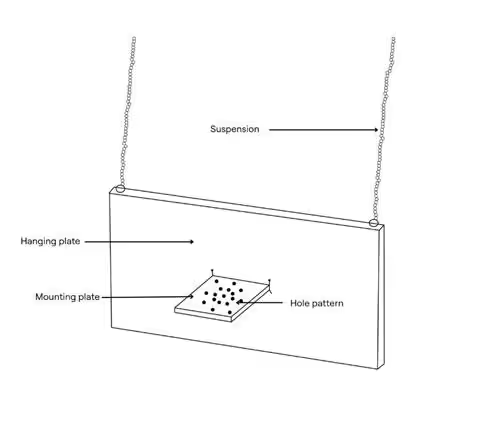
Hanging Mass
Hanging mass configurations often use plates or beams suspended vertically. A hanging plate typically consists of a large flat plate mounted from two top points, allowing limited forward, backward, and lateral movement. The Unit Under Test (UUT) is mounted on a smaller welded plate perpendicular to the main plate. The impact occurs on the back side of the hanging plate, opposite the UUT, generating the desired SRS profile.
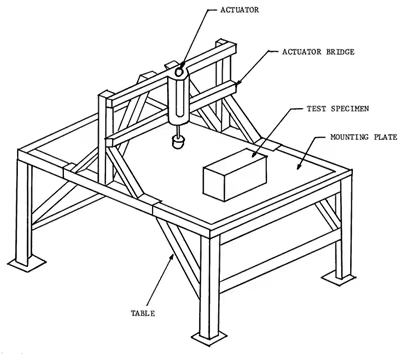
Resonant Plate
Similar to the hanging mass method, the resonant plate is supported horizontally, allowing it to resonate up and down while minimizing lateral twisting. This setup provides flexibility in impact points and UUT mounting locations, enabling fine-tuning of the SRS profile.
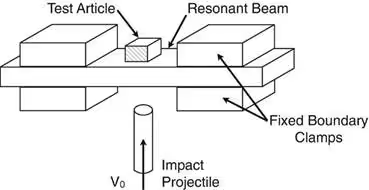
Resonant Beam
The resonant beam configuration resembles the resonant plate but uses a narrower beam supported only at its short ends. This design allows controlled vertical resonance with minimal twisting. UUTs can be mounted at various points along the beam, offering additional tuning capability for the SRS profile.
MGA’s Pyroshock System
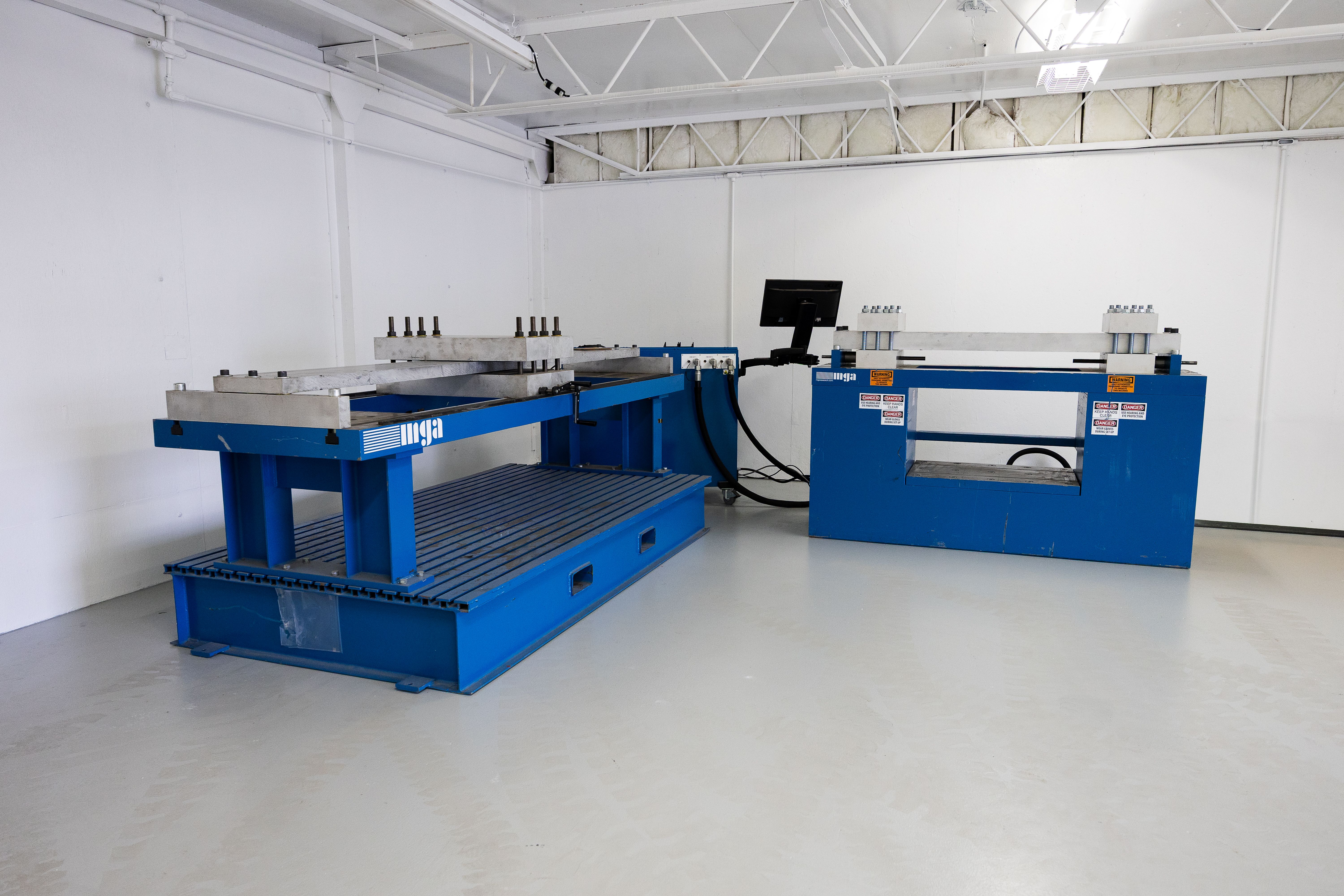
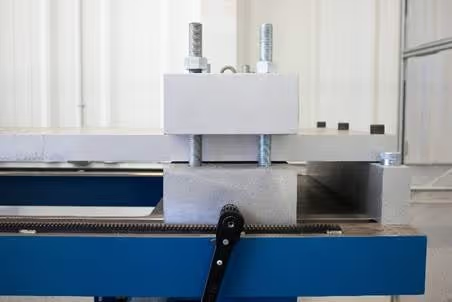
MGA’s pyroshock tables utilize a tunable resonant beam design for maximum flexibility and precision. Our beams come in multiple lengths, widths, and thicknesses, enabling a broad range of SRS profiles.
To generate the shock, we employ a pneumatic cannon powered by compressed nitrogen to fire a free-floating puck into the resonant beam. The cannon is mounted on a T-slot floor, allowing adjustable impact locations for enhanced tunability. Fire pressure can be varied to control energy input, and multiple puck designs with different masses are available for further adjustability.
What sets MGA apart is the tunable nature of our pyroshock system. Adjustable clamps on either side of the UUT allow us to modify the beam’s length and end conditions, allowing for more customized configurations and tuning. Furthermore, by tightening or loosening these clamps to specific torque values, we can manipulate the beam’s stiffness and resonance, achieving precise control over the SRS shape.
The MGA Advantage
MGA’s tunable resonant beam MIPS systems provide a highly adaptable platform for pyroshock testing. By offering adjustable beam lengths, variable end conditions, and customizable impact energy, our systems can replicate a wide range of shock profiles. This flexibility ensures accurate testing for components with unique geometries or demanding specifications. Combined with our ability to fine-tune SRS profiles, MGA delivers reliable, repeatable results that meet the testing requirements of aerospace and defense industries.
We are devoted to significantly investing in the future of space exploration, all while offering our clients the most advanced testing solutions available today, tomorrow, and beyond. If you are interested in learning more about our space and defense capabilities, fill out our contact form today!
Ready to Get Started?
Let's discuss your testing needs and how MGA can help. Our team is ready to provide the expertise and solutions you're looking for.