
Comprehensive Environmental Testing Capabilities in Mississauga
Mar 31, 2026
Aerospace components operate in some of the most demanding environments on Earth. During a single flight, equipment may experience freezing temperatures, rapid thermal changes, and high humidity. For equipment to perform reliably in these conditions, they must first be tested under controlled laboratory environments. Environmental testing recreates these conditions in a safe and repeatable manner before the aircraft ever leaves the ground.
As the next article in our Inside MGA Canada series, we will highlight the testing capabilities available at MGA Research’s Mississauga, Ontario facility. In this overview, we take a closer look at the environmental testing equipment available on site, ranging from reach-in to drive-in chambers. These chambers complement other test equipment located in this facility, allowing us to provide comprehensive testing solutions for the Canadian aerospace industry.
For more information on our capabilities in Mississauga, download our flyer here.
Environmental Chamber Testing for Aerospace Components in Canada
Reach-In Chambers
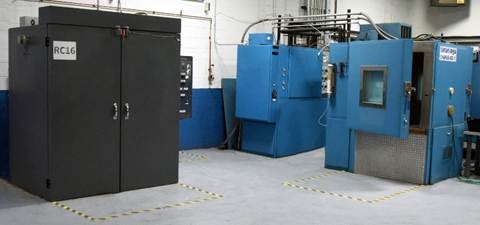
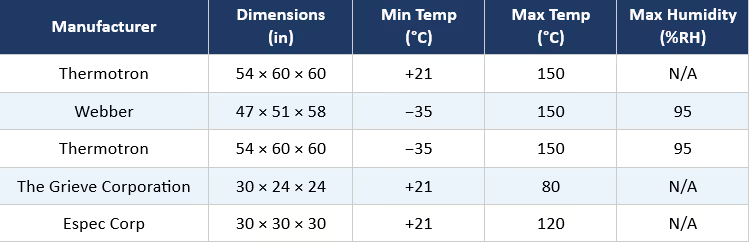
Reach-in chambers are often the starting point for environmental testing in the aerospace industry, particularly during the development phase. Their compact size makes them ideal for evaluating individual components, materials, and subassemblies such as avionics modules, sensors, and connectors in an efficient manner. Our Mississauga facility operates several reach-in chambers from multiple manufacturers, each supporting varying operating windows, as shown in the table below:
Walk-In Chambers
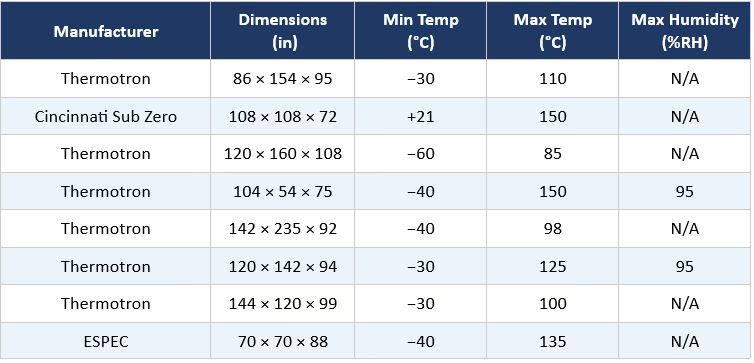
As the next step in chamber size, walk-in chambers provide the additional space required for larger test articles that are unable to fit in a reach-in chamber. These systems are commonly used for testing complete sub-assemblies such as cabin storage systems, seating components, or landing mechanisms. MGA utilizes multiple walk-in environmental chambers at our Canadian operation, with the following specifications:
Drive-In Chamber
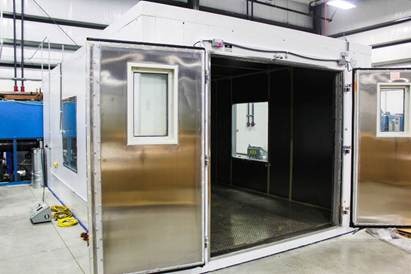
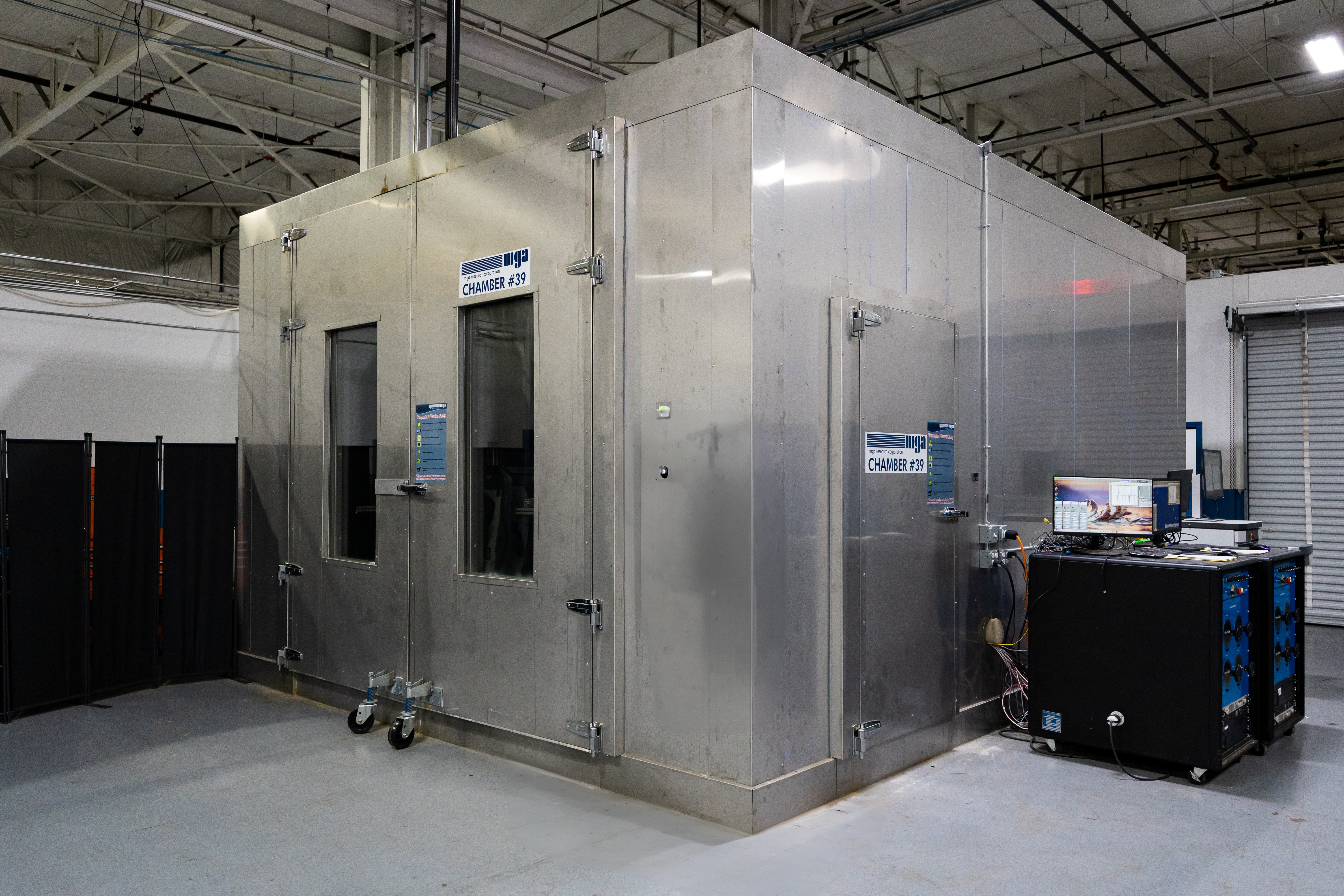
Some test articles are simply too large for traditional environmental chambers. For these cases, our laboratory has recently renovated a drive-in environmental chamber. This chamber allows large components such as structural assemblies, suites, or galleys to be placed directly into the test environment without disassembly.

Common Applications for Standard Environmental Chambers
Thermal Cycling and Temperature Soak
This form of environmental testing may appear to be the simplest mode at first glance, but it provides engineers with valuable information. In short, this test type exposes test articles to fixed or gradually changing temperature conditions for an extended period. Thermal soaks and cycling help engineers to evaluate how materials and assemblies perform across repeated temperature extremes throughout the entire life of an aircraft’s operation. Particularly, these tests help detect cracking, deformation, or loss of function caused by thermal stress.
Applicable Standards:
- DO-160 Section 4 - Temperature and Altitude
- DO-160 Section 5 - Temperature Variation
- MIL-STD-810 Method 501.6 – High Temperature
- MIL-STD-810 Method 502.6 – Low Temperature
- Customer Defined Environmental Test Procedures
Humidity Exposure
A similar environmental testing type introduces controlled humidity conditions alongside specific temperatures. Although low-humidity tests, used to simulate hot and dry environments, are occasionally performed, high-humidity testing is more common within the aerospace industry. This testing helps engineers verify that the test articles are resistant to moisture ingress, condensation, and corrosion in high-humidity environments such as tropical or coastal operating regions.
Applicable Standards:
- DO-160 Section 6 - Humidity
- MIL-STD-810 Method 507.6 - Humidity
- Customer Defined Environmental Test Procedures
MGA Mississauga’s Specialized Environmental Chambers
Thermal Shock Testing for Aerospace Materials and Assemblies
While standard environmental chambers allow for gradual temperature adjustments, thermal shock chambers expose test articles to rapid temperature transitions, typically between extreme hot and cold. These sudden changes introduce significant mechanical stresses within materials and assemblies, making thermal shock testing particularly valuable for evaluating composite materials, bonded joints, and mechanical assemblies with different thermal expansion properties. Here, thermal shock testing is typically performed using the following chamber:

Applicable Standards:
- DO-160 Section 5 - Temperature Variation
- MIL-STD-810 Method 503.6 – Thermal Shock
Customer Defined Environmental Test Procedures AGREE Chambers

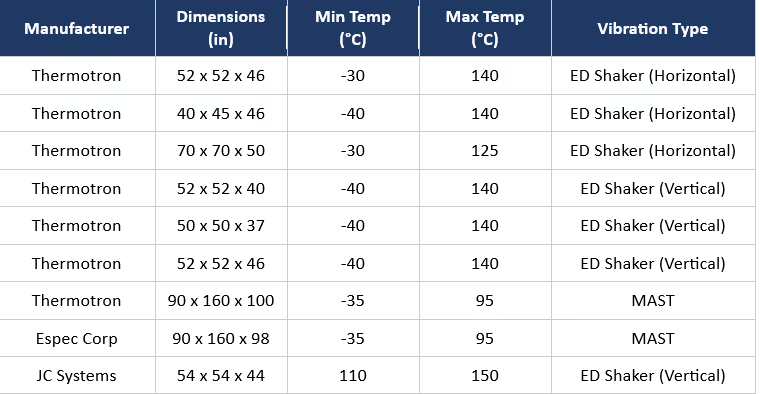
It is common in the aerospace industry that an aircraft may experience thermal and vibrational stresses simultaneously. To help ensure that components can withstand these scenarios, AGREE chambers are used to create this combined test setting. These systems support various temperature ranges for multiple Electrodynamic (ED) shakers and multi-axis simulation tables (MAST), allowing for small test articles up to full assemblies to be tested. Our facility operates several combined temperature and vibration systems, as shown below:
Applicable Standards:
- MIL-STD-810 Method 520.5 – Combined Environments
- IPC and JEDEC electronic reliability standards
- Customer Defined Environmental Test Procedures
Why Environmental Testing is Critical for Aerospace Safety and Compliance
Environmental testing plays a critical role in validating aerospace equipment before it enters service. By simulating operational conditions in the lab, engineers can identify weaknesses early in the design cycle and confirm that components meet regulatory compliance for various industry standards including RTCA DO-160, MIL-STD-810, Transport Canada, and FAA requirements. Together, these tests help aerospace OEMs and suppliers achieve several important objectives such as:
- Improved product reliability
- Increased operational safety
- Reduced risk of in-service failures
The MGA Advantage
MGA’s Mississauga facility offers several advantages for aerospace companies operating in Canada. Specifically, our comprehensive scope of aerospace focused testing directly located in a single facility within Canada provides the local aerospace industry with a complete solution.
Certification related testing frequently requires observation by Transport Canada delegates to validate test procedures and execution. Our facility is accessible to Transport Canada delegates, enabling witnessed testing without requiring customers to arrange for overseas travel or international shipment of test articles. Our team has experience coordinating with customers and TRC delegates to support witnessed test events efficiently.
Moving Forward
MGA Research’s Mississauga facility provides comprehensive environmental testing equipment supporting the full range of temperature, humidity, and thermal shock capabilities required for development and qualification testing in the aerospace industry. From small components to large assemblies, the lab’s chamber inventory enables testing to standards such as DO-160, MIL-STD-810, and OEM-specific environmental procedures. For aerospace manufacturers and suppliers operating in Canada, MGA offers a local testing partner capable of supporting environmental testing alongside our greater portfolio of aerospace focused testing.
As we continue with the Inside MGA Canada series, we will investigate additional DO-160 test modes focusing on harsh environmental conditions and mechanical testing, as well as explore other important test types for the Canadian aerospace industry.
Questions we will answer:
- What options are available for simulating extreme environments?
- How does mechanical testing support durability, reliability, and lifecycle validation?
- Which industries depend on reliable cold‑weather performance testing to ensure safety and compliance?
If you are interested in learning more about our capabilities, fill out our contact form today! To stay up to date with future articles and insights, sign up for our newsletter. For more information on our facility in Mississauga, Ontario, visit https://www.mgaresearch.com/canada.
FAQ: Environmental Testing for Aerospace Components
1. What is the purpose of environmental testing in the aerospace industry?
Environmental testing for aerospace applications simulates real-world operating conditions such as extreme temperatures, humidity, and vibration to ensure components perform reliably during flight and meet regulatory standards like DO-160 and MIL-STD-810.
2. What is DO-160 environmental testing?
DO-160 environmental testing is a set of standardized procedures developed by RTCA to evaluate how airborne equipment performs under environmental conditions such as temperature variation, humidity, altitude, and vibration.
3. What types of environmental chambers are used in aerospace testing?
Aerospace environmental testing commonly uses reach-in chambers for small components, walk-in chambers for larger assemblies, drive-in chambers for full-scale systems, and specialized chambers like thermal shock and AGREE systems for combined testing.
4. What is thermal shock testing and why is it important?
Thermal shock testing exposes components to rapid temperature changes to identify material weaknesses, cracking, or failure due to thermal stress, especially important for composites and bonded assemblies.
5. What industries require environmental testing besides aerospace?
In addition to aerospace, industries such as automotive, defense, and energy (high-voltage batteries) rely on environmental testing to validate product durability and compliance with industry standards.
6. Why is environmental testing important for aircraft safety?
Environmental testing helps identify potential failures before components are deployed in real-world conditions, improving reliability, ensuring passenger safety, and reducing costly in-service issues.
7. Can environmental testing be performed in Canada?
Yes, facilities like MGA Research’s Mississauga lab provide comprehensive environmental testing in Canada, supporting customers in standard requirements without international shipping or travel.
Ready to Get Started?
Let's discuss your testing needs and how MGA can help. Our team is ready to provide the expertise and solutions you're looking for.