
IIHS Releases the Latest Whiplash Results
Feb 10, 2026
*Article was updated 02/25/2026
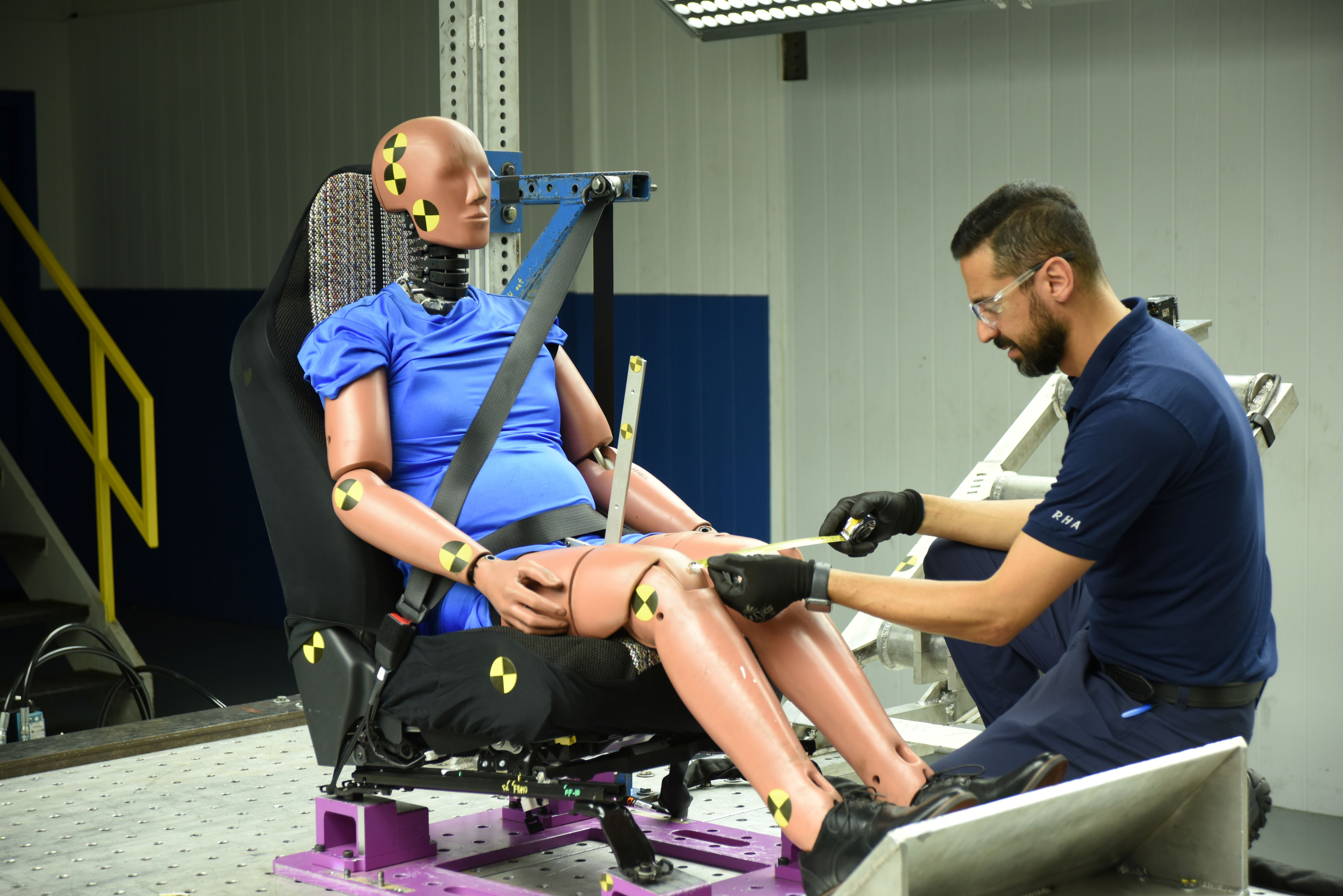
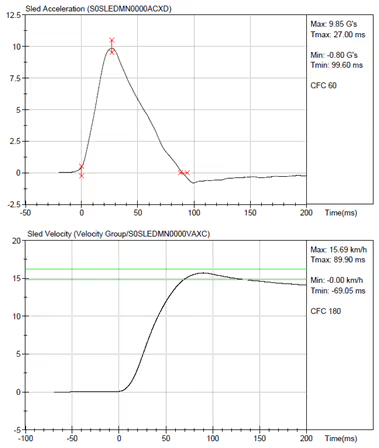
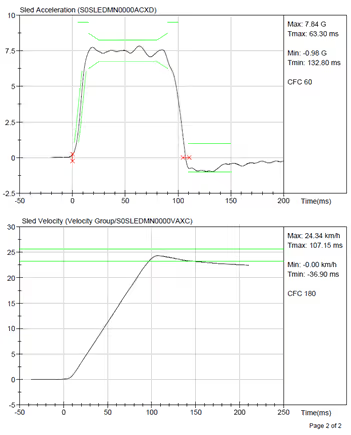
The Insurance Institute for Highway Safety (IIHS) has been working on the next iteration of whiplash evaluation since 2022. This was when the Rear Impact Protocol test program was concluded due to the industry achieving good results virtually across the board. This updated protocol includes several new metrics including pelvis displacement and NKM (defined using neck shear force and bending moment). In addition to the current pulse, IIHS has also incorporated an additional sled pulse with the new protocol simulating crash speeds of 20 and 30 mph. IIHS released this video to explain further the effort undertaken with the new whiplash test.
Background
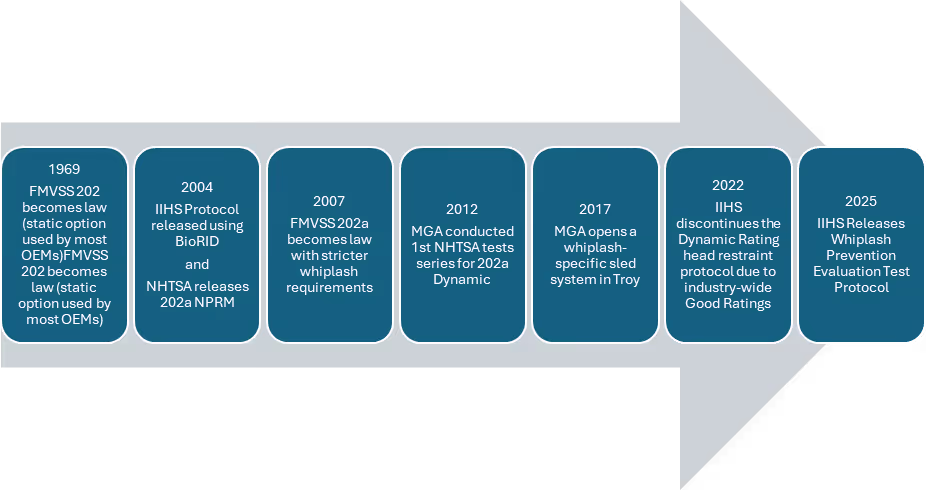
Federal Motor Vehicle Safety Standard (FMVSS) 202a – Head Restraints and Insurance Institute for Highway Safety (IIHS) Head Restraint Dynamic Protocol are industry-standard whiplash tests. Although different in many ways procedurally, both test protocols set forth criteria pertaining to the dimensional and safety requirements for head restraints in low-speed rear crashes involving passenger vehicles, multipurpose vehicles, trucks, and buses. Starting with the original FMVSS 202 standard in 1969, head restraint development around occupant protection in whiplash test scenarios has reached high performance levels in most vehicle types over the last 50+ years. In 2022, IIHS discontinued the testing since all recent testing had resulted in Good for every vehicle tested. In December 2025, IIHS published an updated protocol intended to improve the evaluation of seats and head restraints in whiplash crash scenarios.
Whiplash Experience
MGA’s facility in Troy, Michigan has been conducting whiplash testing for over 20 years. Early testing began with OEMs responding to the initial IIHS protocol for whiplash. The goal of evaluating current designs and then to validate additional design changes was critical to gaining an understanding of the new whiplash requirements. Soon after, seating suppliers began developmental testing to evaluate new head restraint designs. Beyond the standard instrumentation of the BioRID I, MGA offers additional instrumentation with the dummy, on the seat, and high-speed video analysis. The additional data offered better analysis of the biomechanics of the dummy and energy management properties of the seat.
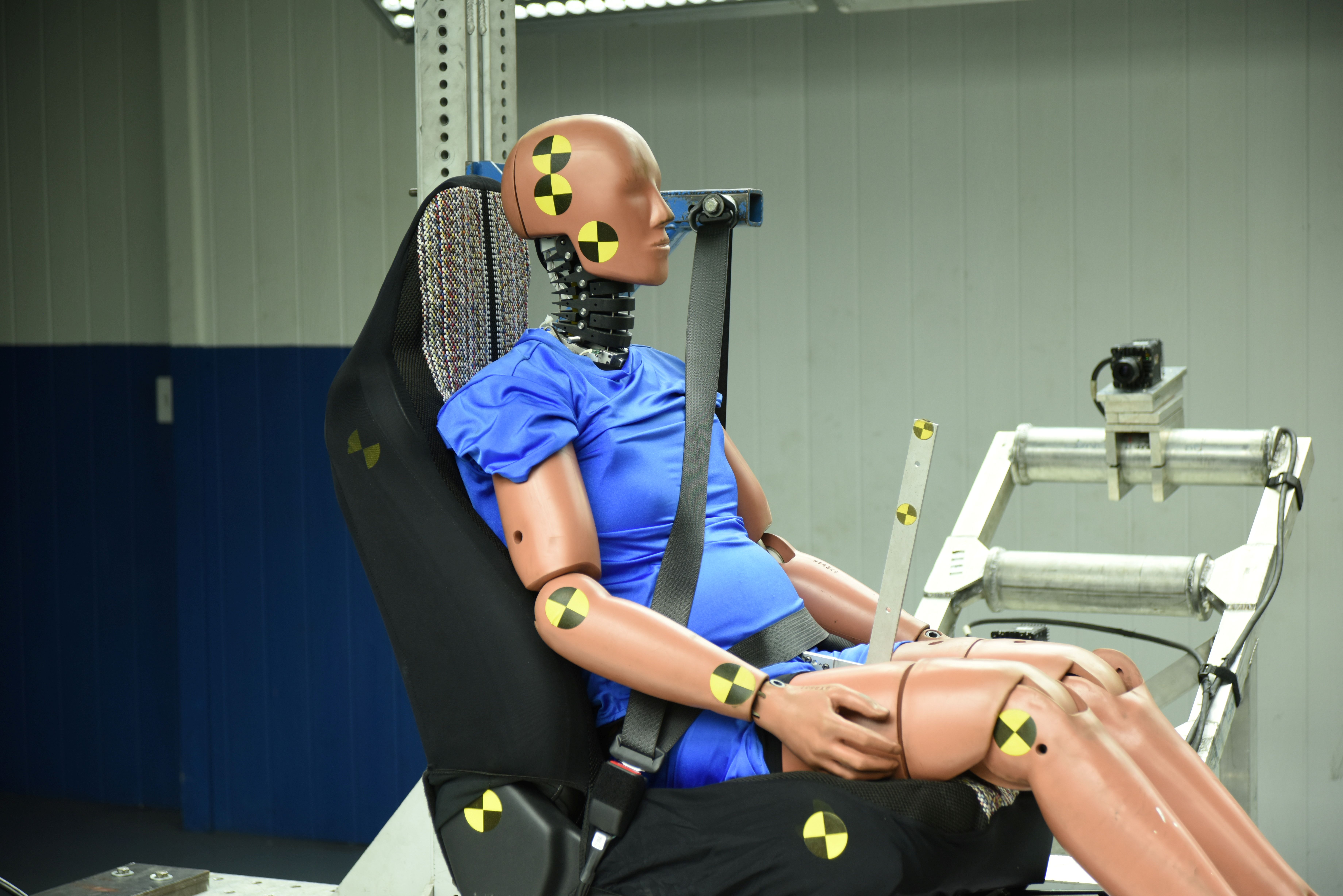
The positioning of the BioRID II is key in test execution. MGA’s procedures and training have been developed and refined over the years. Establishing tolerances of seat measurements using the SAE J826 H-Point machine that is tighter than industry standards ensure test repeatability. There are multiple variables in a seat’s design that can affect the test. The tightening of tolerances for test execution enables MGA to minimize outside variables.
MGA currently has three BioRID II ATDs in house. The implementation of scheduled calibration ensures that MGA always has availability for testing, Additionally, MGA has developed a state-of-the-art sled that was designed specifically for whiplash evaluation. This sled is solely used for FMVSS and IIHS protocols.

The New Protocol
The updated IIHS protocol Whiplash Prevention Evaluation Test Protocol (Version I, December 2025) can be found here. Per the IIHS data release video, the intention of the updated protocol was to more closely align the whiplash component testing to the data seen in real-world crashes. Every aspect of the old protocol was evaluated for improvement. The following table illustrates the differences between the original IIHS protocol and the newest version. For the new teat, the summation of total demerits (max 18) determines the rating. Only 1 demerit value is assigned per metric (worst-case).

FAQs
1. What sample rate do you collect data at?
10,000HZ. It is the same that IIHS uses. MGA can increase to 20,000 HZ if requested.
2. Where on the dummy is backset measured from?
1.3.4.10 A) Record the most rearward point on the centerline of the dummy’s skull cap. B) Measure backset which is the horizontal distance between the rearmost point on the dummys head and the head restraint point @ test position marked in step 1.3.3.6. (As seen in Whiplash Prevention Evaluation Test Protocol Version 1)
3. Is there new instrumentation on the BioRID for this test?
IIHS collects head gyro Y, pelvis gyro Y, and T1 gyro Y. MGA has added these channels as well. They aren’t used for the rating score, but they are collected.
4. Is MGA using the HRMD at all for this test?
Since it is not in the Whiplash prevention evaluation test protocol, it is not being used. Instead, we are using the calculation method and the IIHS dummy seating form to calculate these values.
5. How will IIHS be auditing data that is submitted?
Referring to the Auditing Methods Section 7: After receiving the corresponding submission data by either physical test or simulation, IIHS will select one of the two load cases at random to audit the submitted data by conducting the physical test at IIHS. That test data will be evaluated and compared to the OEM submission. See protocol for additional steps taken if results don't correlate.
6. Regarding BioRID backset setting, it is verified prior to the test running using the feelers. How are you correlating the physical distance versus dummy setting using the CMM?
MGA uses the feelers to pre-position the BioRID dummy. Once the dummy is seated properly, CMM points are used to verify backset and other measurements (Hpoint, Test Position Horizontal, Test Position Vertical, etc.).
7. Can you discuss Nkm versus Nij neck injury criteria used?
Nij involves tension and moment and is typically used in high-speed frontal crash evaluation, while Nkm involves shear force and moment and is used in low-speed rear impact crash evaluation.
8. Is the head and pelvis relative velocity calculated purely using accel data or any video analysis involved?
Yes, using the protocol steps to calculate. Video analysis is not being used.
9. To be clear, you calculate backset, but then check it against a physical HRMD to validate the calculation?
Euro NCAP doesn't require any HRMD. No, the HRMD is no longer used in this test.
10. Euro NCAP also follows OEM design torso angle. Is IIHS sticking to 25 Deg?
Yes, per the protocol, IIHS will be using 25 deg torso angle for all testing with the stated tolerance.
11. Does the OEM have to submit data or will IIHS randomly test vehicles as in the pat?
For the new protocol, OEMs must submit data using one of the two categories (physical or simulation) in order to get a public rating from IIHS. See the protocol for additional information.
Ready to Get Started?
Let's discuss your testing needs and how MGA can help. Our team is ready to provide the expertise and solutions you're looking for.