
A Look Inside Photogrammetry at MGA Research Corporation
Jun 18, 2026
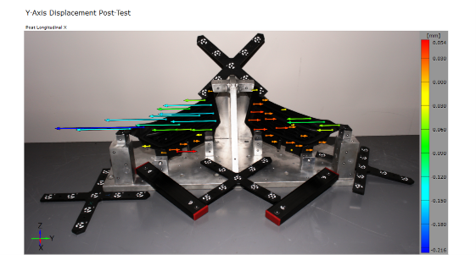
Photogrammetry is a field of science and technology that uses photographic images to derive reliable information about physical objects depicted in them. There are multiple types of photogrammetry, ranging from simple measurements found in photos to the creation of 3D models and the extraction of accurate color ranges. At its core, photogrammetry aims to do the opposite of photography: rather than take a 3D view and make it 2D, it aims to take 2D images and create a 3D view.
Close-Range Photogrammetry
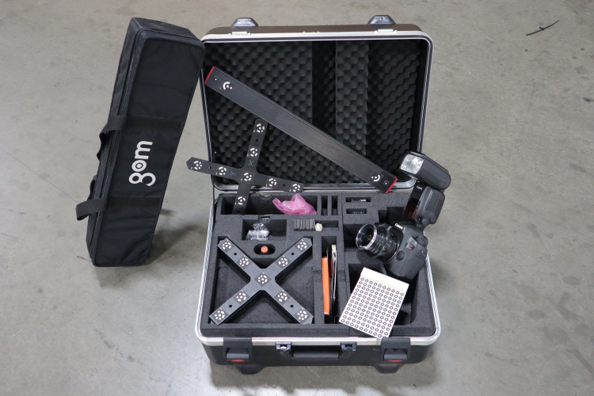
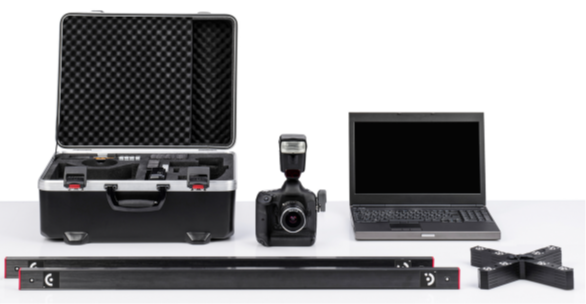
Within the sphere of physical testing, the most common type of photogrammetry is “Close-Range Photogrammetry”. This refers to the collection of photographs typically taken with a handheld or tripod-mounted camera, as opposed to aerial or orbital photography. These photographs are typically of smaller structures or components that need to be precisely measured in a relative manner. Photographs are taken at multiple angles, and reflective targets are used for accurate point location.
What is Measured and Captured Using Photogrammetry?
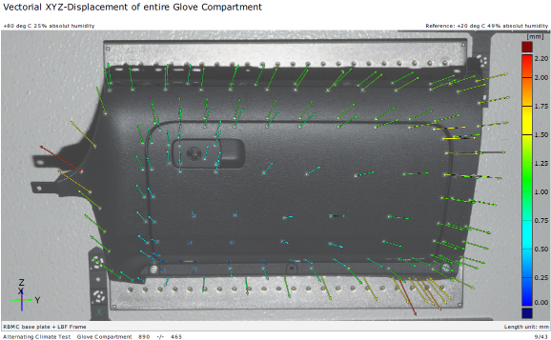
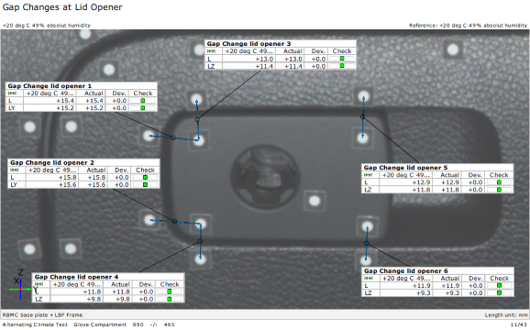
With images from multiple angles, reference points, and some form of scale, it is possible to utilize software to locate all the images in 3D space. From here, a variety of non-contact measurements can be made. Most commonly seen in the testing industry are relative measurements that track conditions before and after testing activities. This can include impact testing, climate testing, durability testing, or any other test in which the post-test condition is important relative to the initial condition.
Additional measurements that can be captured using this method are gap, flush, overall lengths, and relative movement of components. All these methods combined make photogrammetry a convenient, non-contact method for measuring the performance of a test sample across various use cases and throughout its life.
How Photogrammetry is Done
The typical test process begins with defining what needs to be measured and understanding the areas of concern, such as the entire sample, gaps, or kinematics. Uncoded reference points are placed wherever a measurement is needed; they are stickers with enough tack to hold through thermal testing yet remain removable.
Once the uncoded points are applied, the coded points and scale bars are set up for a “photoshoot” to take place. The coded points and scale bar serve to provide known positions for stitching together all the images and providing known measurements, respectively.
With everything in place, the photoshoot can be performed. With the center of the sample as the focal point, an umbrella of images is captured; these images use the coded points to stitch them together, placing each uncoded point in 3D space. These photoshoots can be performed at any test stage and allow for the evaluation of relevant measurements.
Advantages of Photogrammetry
Due to the way data is acquired, these systems are extremely versatile. Compared to 3D scanning or conventional measurements, photogrammetry is much faster to execute, so long as the reference points are placed correctly at the beginning of the test. Additionally, if temperature compensation is correctly accounted for, measurements can be performed at various temperatures, making detailed measurements at extreme thermal conditions easier to execute.
The MGA Advantage
With European OEMs leading the charge, many are adopting photogrammetry as a preferred method for measuring both interior and exterior components. MGA moved to meet this demand and has been supporting photogrammetry since 2018. The most common commodities serviced are interior trim, exterior trim, bumpers, instrument panels, door panels, and headliners. While not an exact replacement for 3D scanning and more traditional CMM work, photogrammetry provides a more dynamic means of measuring how a product will behave given its conditions. MGA supports all these measurement types, allowing for a robust suite of options for any measurement need. Our facilities have photogrammetry services available in South Carolina and Alabama with the ability to ship to other locations as needed.
If you are interested in learning more about how photogrammetry can support your upcoming project, reach out to us at www.mgaresearch.com/contact.
Ready to Get Started?
Let's discuss your testing needs and how MGA can help. Our team is ready to provide the expertise and solutions you're looking for.