
EV Battery Mechanical Abuse Testing: Crush, Impact, and Nail Penetration Capabilities
Jun 2, 2026

As battery technologies continue to evolve, including new chemistries (lithium sulfur, lithium iron, sodium-ion, etc.) and cell architectures (4680 cylindrical, blade, etc.), evaluating and analyzing the safety and durability of individual cells is becoming increasingly important. In addition to electrical testing focused on assessing a cell’s performance, mechanical abuse testing plays a critical role in evaluating how battery cells respond to severe physical damage, including crush exposure, impacts, and nail penetration.
At MGA, we have three labs with various capabilities to perform abuse testing on battery cells: Holly, Michigan; Akron, New York; and Burlington, Wisconsin. Our facilities are equipped with multiple crush systems, dynamic impactors, and nail penetration systems capable of replicating a wide range of real-world abuse scenarios. These systems allow our teams to test different cell formats while capturing detailed performance data during critical events.
For more information on our battery capabilities, download our brochure.
Flexible Testing Systems for Various Crush Scenarios
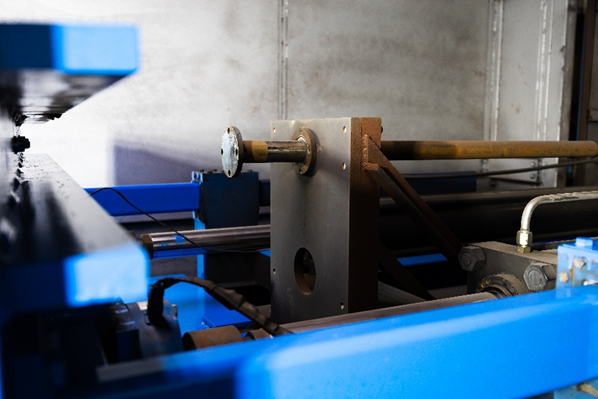
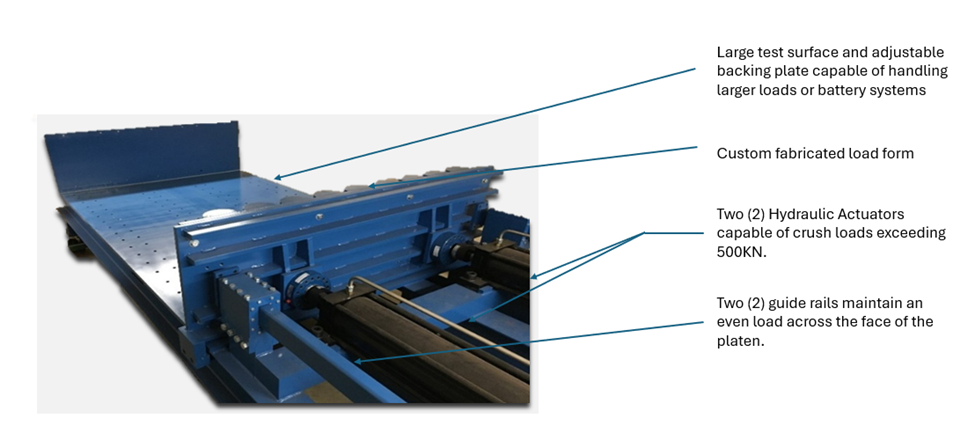
One of the key advantages of MGA is the flexibility of our equipment division to engineer and build mechanical testing equipment that meets the needs of the product and test requirements. An example of this is battery crush testing. Our labs operate a multitude of crush systems of varying size and force capacity, allowing us to accommodate different battery cell formats and testing conditions.
The crushers range from a small precision crusher designed for lower-force tests and controlled-penetration events to a large, high-capacity crusher capable of delivering significantly higher loads. The system selected for a test depends on several factors, including the cell or module size, required maximum force, and the speed at which the test must be conducted. The table below outlines MGA’s crush system capability:
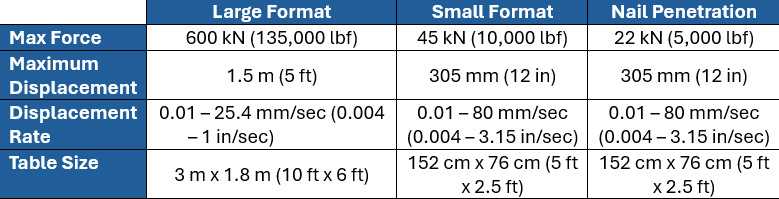
Our crush systems are hydraulically powered, with control provided by MGA-produced hardware and software. The systems can operate as slowly as 0.01 mm per second for highly controlled quasi-static testing, while supporting a wide range of test speeds depending on the applicable standard and test objective. Higher speeds, up to 25 mm/s on the large-format crush system and 80 mm/s on the small-format system, can be used to represent more dynamic mechanical loading conditions while remaining within the scope of quasi-static cylinder-based testing.
Impact Testing and Dynamic Loading
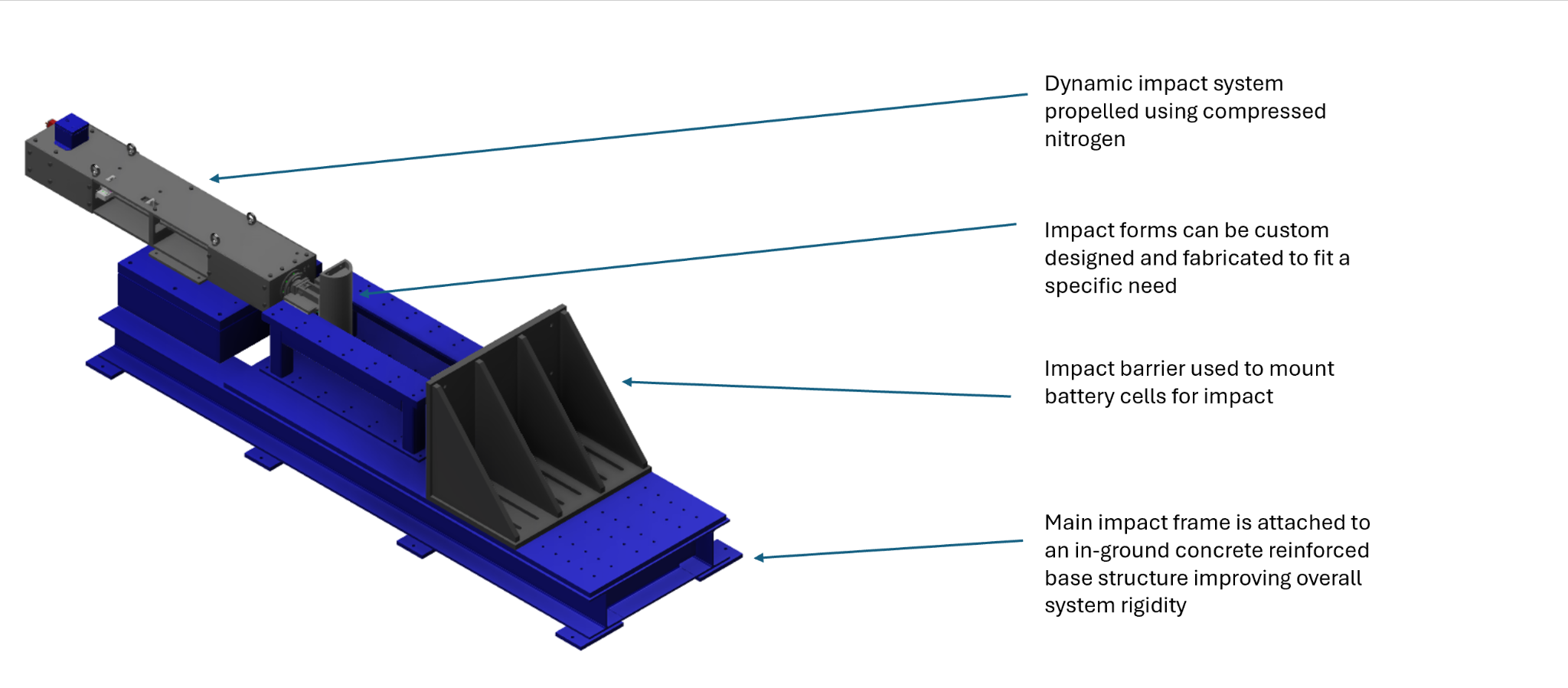
In addition to crush testing, MGA also performs dynamic impact testing using nitrogen-propelled load forms. These systems can be configured for either horizontal or vertical impacts (see Understrike: Critical Safety Testing for Electric Vehicle Battery Systems), allowing the team to reproduce a variety of impact scenarios.
The impact equipment and testing are contained within a dedicated battery abuse test bunker equipped with its own forced-air evacuation system. This ventilation system helps to disperse smoke safely and exhaust fumes that may be produced if a battery vents or enters thermal runaway during testing.
The impact system can operate at velocities ranging from 0.5 meters per second up to 6 meters per second, providing flexibility for both lower-energy and high-energy impact scenarios. A mini carriage system with high mass is also available for testing smaller components or cells on the horizontal impactor.
To achieve different impact conditions, MGA utilizes a variety of interchangeable load forms, with the most common configuration being flat or hemispherical shapes. Instrumentation on the impact system includes load cells and accelerometers, both collected via a data acquisition system (DAQ) at 10,000 Hz, along with a laser speed trap for precise velocity measurement. For detailed visual analysis, tests can also be recorded using high-speed video at up to 20,000 frames per second, paired with video tracking used to evaluate deformation and signs of failure during impact events.
Nail Penetration Testing for Internal Short-Circuit Evaluation
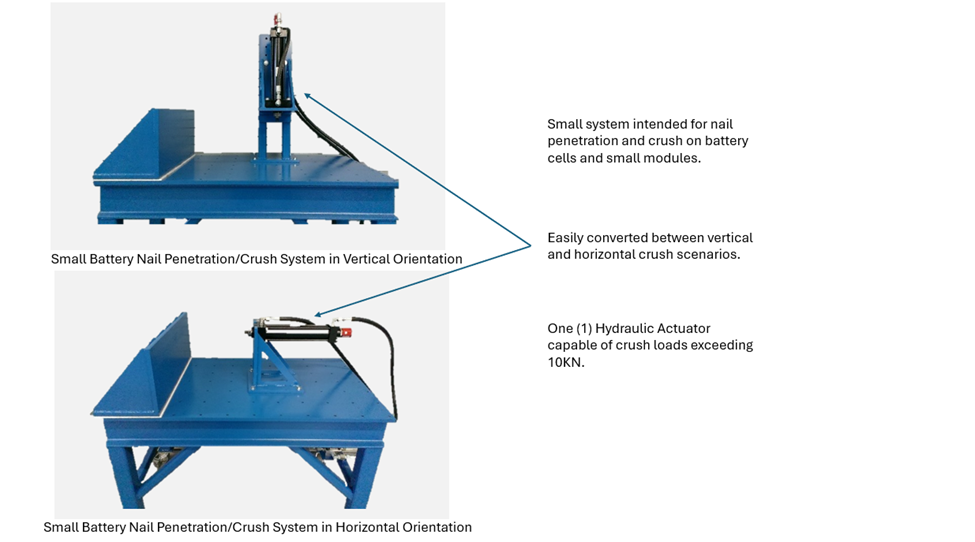
Nail penetration testing is commonly used to evaluate how a battery cell responds to a simulated internal short circuit. Internal short circuits can result from factors such as material impurities, dendrite growth, or other cell inconsistencies and may be evaluated using methods such as nail penetration or external and internal heater-induced thermal events. At MGA, nail penetration tests are performed using highly precise displacement- or load-controlled hydraulic systems, integrated with both large and small crush systems, to ensure accurate, repeatable test conditions.
The system can accommodate a range of nail sizes depending on the test requirements. MGA has conducted tests using nails ranging from 1 mm to 5 mm in diameter, with the capability to support larger sizes if needed.
For advanced thermal monitoring, MGA has also used 3 mm hollow nails, allowing a thermocouple to be inserted directly into the nail. This enables engineers to monitor nail temperature in real time as the nail penetrates the cell.
Additional instrumentation can be used to measure electrical response during penetration. Voltage leads attached to both the nail and the cell allow observation of how the electrical characteristics change as the nail passes through different internal layers of the battery.
Using the same hydraulic controller as the crush system, we are able to achieve high precision motion control of the nail using either force or displacement feedback.
To support safe handling after testing, the facility also includes multiple battery cyclers that allow damaged cells to be discharged when thermal runaway does not occur immediately.
Safe Handling Before, During, and After Testing
To ensure the safety of all individuals involved in abuse testing, MGA utilizes a range of precautionary equipment/practices. All abusive testing is performed within MGA-built abuse bunkers consisting of 4” thick concrete reinforced steel walls. Air evacuation systems are integrated into each bunker to provide rapid exhaust removal in the event of a thermal event. Following testing, all cells are evaluated for signs of potential remaining energy and discharged or destroyed as needed prior to being recycled using an outside service. Undamaged, but tested, cells are packaged using customer-provided shipping materials and returned as needed.
Custom Fixture/Fabrication
To support unique test configurations, MGA also has in-house fabrication capabilities at our Akron, New York; Grand Blanc, Michigan; and Troy, Michigan test labs capable of producing custom fixtures and load forms. This allows our engineers to offer full test solutions under one roof to our customers and to quickly adapt test setups to meet specific program requirements or specialized cell geometries.
Partner with Us in Your Testing Needs
With the rapid advancement of electric vehicles and battery technology, a capable partner for cell evaluation through testing is critical. MGA’s personnel and equipment capabilities offer a one-stop approach to progress through battery cell development and validation test plans. By combining flexible testing systems, custom fixture design, and advanced instrumentation, MGA’s battery testing labs provide solutions for studying battery cell behavior during some of the most rigorous real-world scenarios.
Contact MGA Research today to learn more about our battery testing capabilities and services.
Ready to Get Started?
Let's discuss your testing needs and how MGA can help. Our team is ready to provide the expertise and solutions you're looking for.