
MGA Supports Large Bus Industry Through 6-Post Durability Testing
Oct 15, 2026
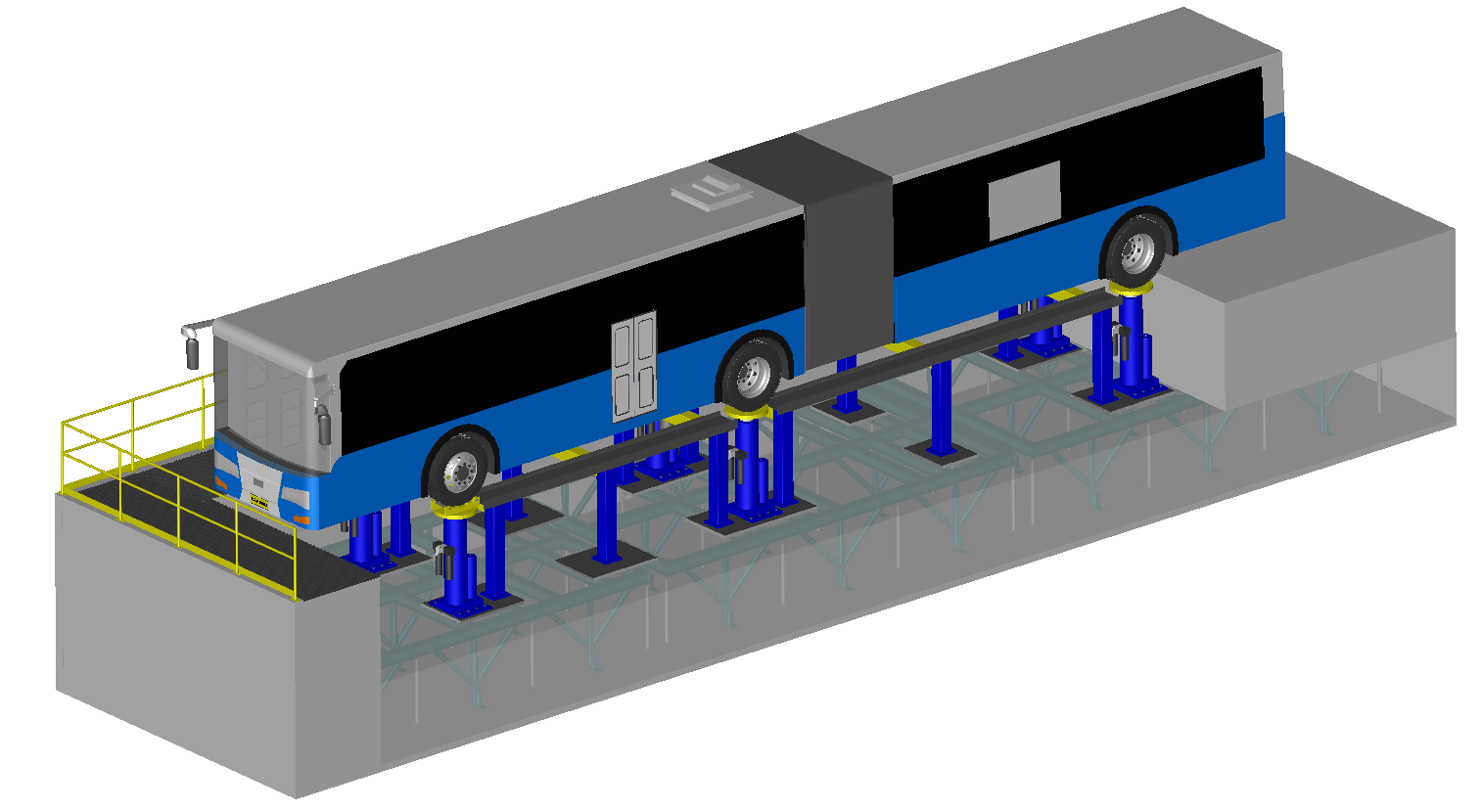
MGA supports various industries by providing innovative test solutions to evaluate various types of transport products. Over a number of years, facilities have been developed which are ideally suited to conduct durability testing on large trucks and buses. These facilities include direct wheel coupled techniques utilizing an MTS 329 system, as well as large multi-post vertical pedestal actuator systems for large transit buses. Recently, a project was undertaken for a large city articulating bus. The system used was an in-ground 6-post facility located at MGA’s Maple Road test laboratory.
Utilizing the 6-Post System
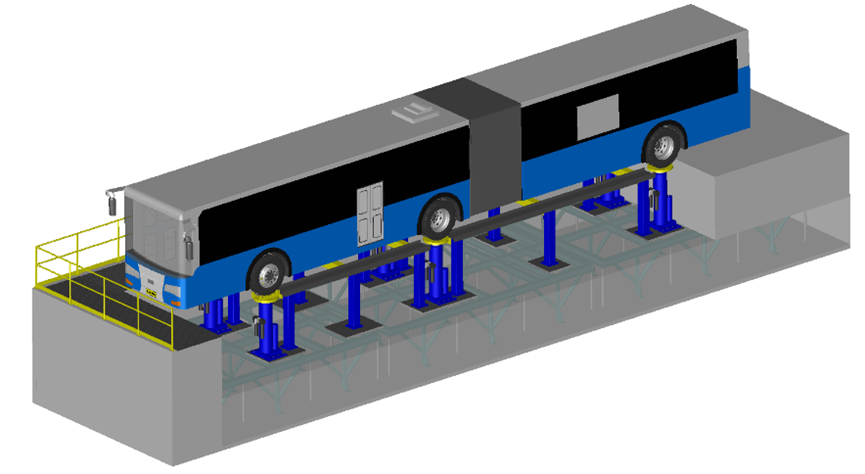
The in-ground 6-post system consists of a large below-floor bed plate anchored to an inertial mass, 6 vertical actuators that can be tailored to the vehicle's track and width, and an accessible pit for under-vehicle inspections. The 6-post test is conducted using hydraulic actuators, each capable of applying 245 kN of force in the vertical direction. Each actuator will excite the wheels individually to achieve the desired wheel acceleration and strain gauge responses. A 5-ton overhead crane is used to handle any heavy-duty maintenance on the bus. The system is equipped with vortex shock coolers to support accelerated testing.
Test Procedure
Road Load Data Acquisition (RLDA) was first carried out on various public roads and commercial proving grounds. The goal in this process is to substitute proving ground road events that provide similar net damage as to what is experienced on the public roads. To synthesize and equate proving ground road events to the public road events, specialized software is used to analyze/process all the data to optimize the durability test sequence that is used with the 6-Post test system.
In general, the lifetime usage of a public bus is based upon total miles. Based upon a goal of simulating 500,000 miles of public/city road usage, proving ground events were added with repeats using an iterative method. The final duty schedule resulted in approximately 6 months of 6-Post testing including periodic inspections. This total timeframe from RLDA to 6 Post test completion was approximately 8 months which simulated 10+ years of real-world usage.
Testing Takeaways and the MGA Advantage
The key takeaway here is that MGA can simulate real-world roads in the lab environment to accelerate new product development. The testing is conducted in a controlled environment where large deviations in the strain response will automatically stop the test for inspection to ensure overall test accuracy. This approach allows customers to thoroughly evaluate their products and gain confidence in future real-world performance.
We will be featuring more of our hydraulic durability testing capabilities at the upcoming Automotive Testing Expo in Novi, Michigan on October 27-29, 2026. Visit us at Booth #T1440.

Helpful Resources
- To learn more about our hydraulic durability solutions, visit Hydraulic Durability and Chassis Testing.
- Contact our team today to receive a quote or to discuss your next program needs.
Ready to Get Started?
Let's discuss your testing needs and how MGA can help. Our team is ready to provide the expertise and solutions you're looking for.