
Mechanical Testing in Canada: Simulating Vibration Stresses at MGA Mississauga
Aug 11, 2026

Mechanical stresses are a well-recognized source of durability and reliability issues in both aerospace and automotive applications. From sudden shock events to long-term vibration conditions, these scenarios can gradually degrade performance or lead to part failures while in the air or on the road.
To help evaluate a product’s ability to withstand these risks, mechanical testing is commonly used throughout product development and qualification programs. By simulating these real-world mechanical environments in a controlled laboratory setting, MGA helps our customers identify potential weaknesses so that they can be addressed before production.
In this installment of the Inside MGA Canada series, we will outline several common mechanical failure modes for aircraft components, and the testing approaches used at MGA Research Corporation to replicate their underlying causes.
Failure Mode: Sudden Mechanical Events
Turbulence, hard landings, taxiing and other aircraft operations can introduce sudden mechanical shocks. Landing gear and structural assemblies experience high-impact loads during landing and taxi operations. Electronic equipment and other onboard systems may be exposed to shocks caused by turbulence, engine operation, takeoff and landing. Depending on the severity of the impact, this can lead to the immediate failure of components. Thus, shock testing is performed to replicate these conditions in a lab setting. Most often, MGA tests to the following standards:
- DO-160 - Section 7
- Operational Shock
- Crash Safety – Impulse and Sustained Shock
- MIL-STD-810 516.8
- Functional Shock
- Transportation Shock
- Crash Hazard Shock
- IEC 60068-2-27
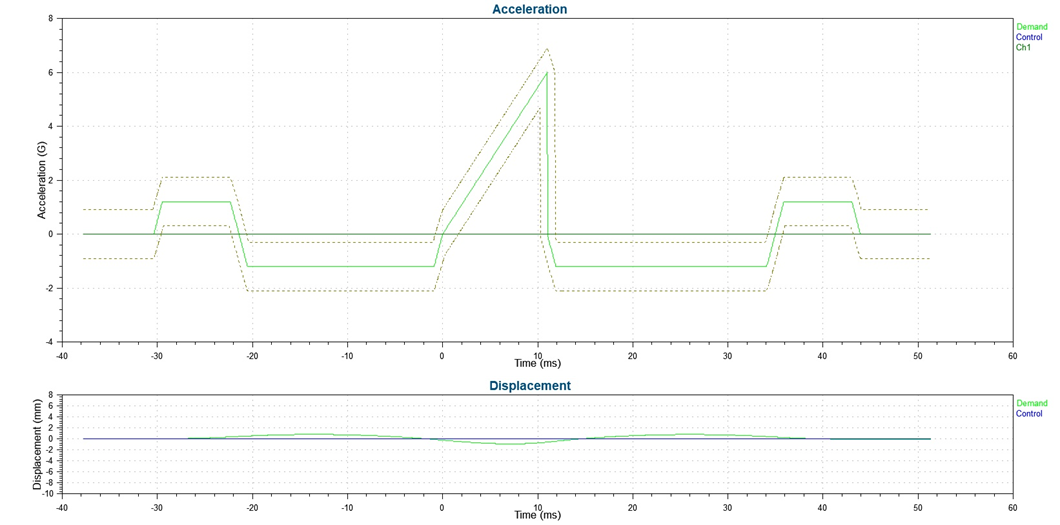
At MGA, shock testing is performed using Electrodynamic (ED) shakers with shock pulse specific modules. Depending on the event, various profiles can be generated such as: half-sine, sawtooth, or trapezoidal pulses. As an example, MGA can subject a suspension component to a shock pulse, simulating the impact of a vehicle striking a pothole.
Failure Mode: Continuous Vibration
Some mechanical stresses do not occur in a single instance, but rather are a result of sustained loading. Continuous vibration from sources such as an engine’s operation, rotor imbalance, and aerodynamic buffeting can all lead to fatigue over time. This is where vibration testing plays an important role. Parts such as seating assemblies, control components, and furniture/overhead bins are commonly subjected to various vibration profiles to simulate the forces they will experience during the aircraft’s life, or to evaluate when unwanted resonance may occur.
MGA has a wide assortment of ED shakers at our Mississauga facility, capable of producing multiple waveforms. Each of these profiles are unique, and are used to achieve different goals:
- Sine: Used to identify a product’s resonant frequencies and structural response.
- Random: Simulates real-world vibration environments.
- Sine-on-Random: Combines the cyclic sine waveform with random vibration to represent complex operating conditions.
MGA’s inventory of ED shakers is suitable for supporting components and assemblies such as hydraulic pumps, alternators, electronic modules, and control units. The products are commonly tested to the following standards:
- DO-160 - Section 8
- MIL-STD-810 514.8
Failure Mode: Multidirectional Structural Stress
Although standard vibration testing with ED shakers is an incredibly useful tool, components are rarely, if ever, subjected to loading in just a single axis. Typically, components are exposed to stresses in multiple axes simultaneously, leading to assembly fatigue, fastener loosening, and distortion of components. Therefore, MGA’s Multi-Axis Simulation Tables (MAST) are used to replicate these combined loading conditions.
Our MAST systems are designed for control over six degrees of freedom, allowing for translation in the X, Y, and Z axes while simultaneously including pitch, yaw, and roll rotation. In Mississauga, our MAST tables have dimensions of 5’x7’ to 6’x8’, allowing for small components, all the way up to large assemblies, to be exposed to simulated flight conditions.
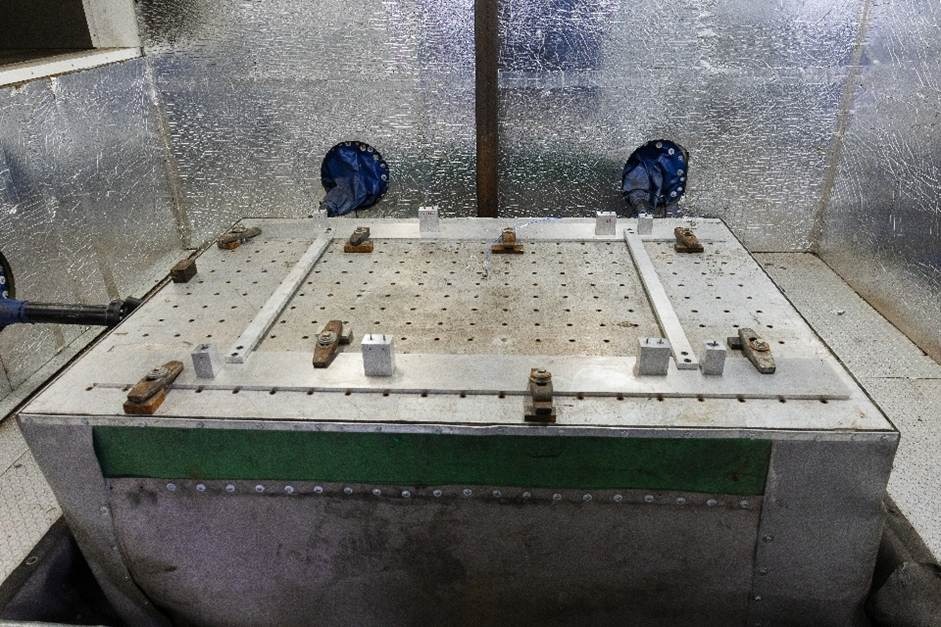
For inside look into the MAST systems in Mississauga, watch this video: https://youtu.be/Mao7Y-LMhx8?si=vGFPb3gWXTqBi36n
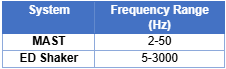
ED shakers and MAST tables provide similar functions, but their use cases are slightly different. Particularly, MAST testing is chosen when the focus is strictly on exposing the test article to vibrations in all three axes simultaneously. However, the other primary reason for choosing a MAST table over an ED shaker is that lower frequencies can be produced. This is useful for simulating loads when traveling over a road, runway, or ground surface, especially important for testing landing gear components. The standard frequency range for these two pieces of equipment is shown below:
Failure Mode: Mechanical and Thermal Combined Stresses
It is not uncommon for aircraft operating in Canada to experience extreme weather, including high heat, humidity, and freezing conditions. Temperature and humidity changes can alter the mechanical properties of various materials or cause unwanted expansion/contraction of components. When combined with vibration or shock loading, failure modes may appear that wouldn’t arise under isolated scenarios.
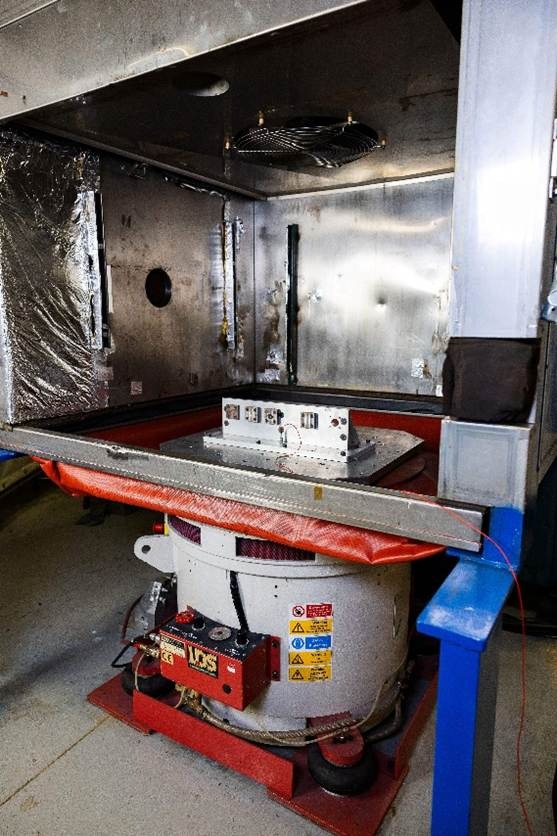
To solve this problem, MGA frequently performs combined environmental and vibration testing by using ED shakers or MAST tables paired with integrated AGREE chambers. The vibration tables generate mechanical stresses using any of the previously mentioned methods, while the AGREE chambers condition the environment to configurable temperatures. These temperatures can remain constant or can be cycled across multiple temperatures throughout the full range of -40 to 140 °C. This opens up a wide range of adjustability, allowing MGA to replicate nearly any real-world vibration environment. External parts of the aircraft that are exposed to fluctuating temperatures, such as avionics, wing control surfaces, and landing gear are commonly tested using this method.
MGA Advantage
Our engineers at MGA’s Mississauga facility have a deep knowledge base of performing mechanical testing, particularly for the aerospace industry. By having local testing capabilities directly within Canada, our customers can eliminate the logistical complexities involved with sending hardware internationally. MGA understands the importance of performing mechanical testing and is happy to work with our customers during their development and certification programs.
For the next article in our Inside MGA Canada series, we will explore fatigue and lifecycle testing, focusing on how long-term durability is tested for aerospace applications.
If you are interested in learning more about our capabilities, fill out our contact form today! To stay up to date with future articles and insights, sign up for our newsletter. For more information on our facility in Mississauga, Ontario, visit https://www.mgaresearch.com/canada.
Ready to Get Started?
Let's discuss your testing needs and how MGA can help. Our team is ready to provide the expertise and solutions you're looking for.